
History of Dvorec Selo
The manor was built between 1762 and 1765 for Josip Desselbrunner, owner of the first and largest cloth factory in Carniola, which stood across the road. It later served as army quarters with a stud farm, a school and a depot. Today it is a restored listed monument.
- Built
- 1762–1765
- Commissioned by
- Josip Desselbrunner
- Architect
- Lovrenc Prager
- Style
- Baroque classicism
- Facade
- 15 bays, 9-bay centre
- Protection
- listed monument, EŠD 1119
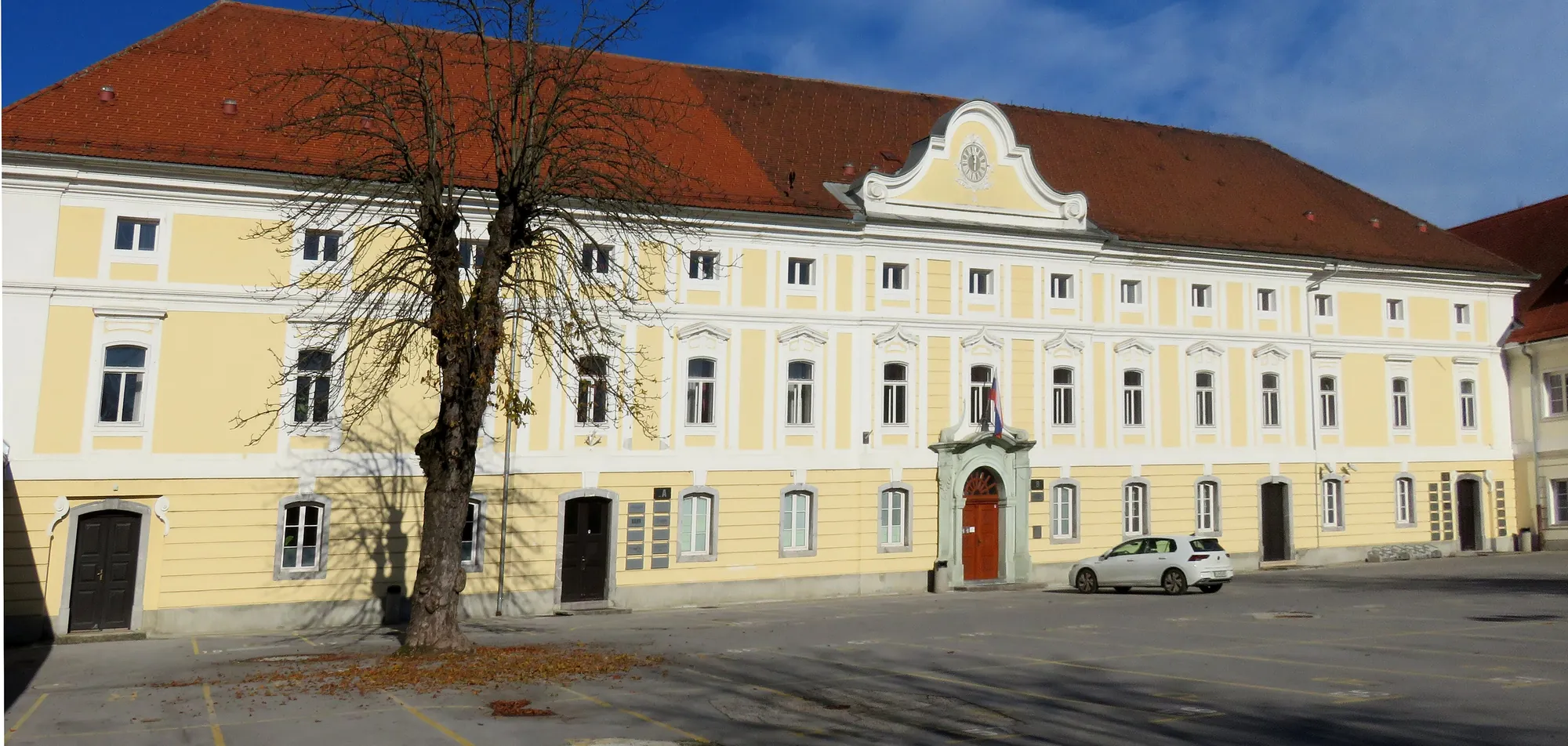
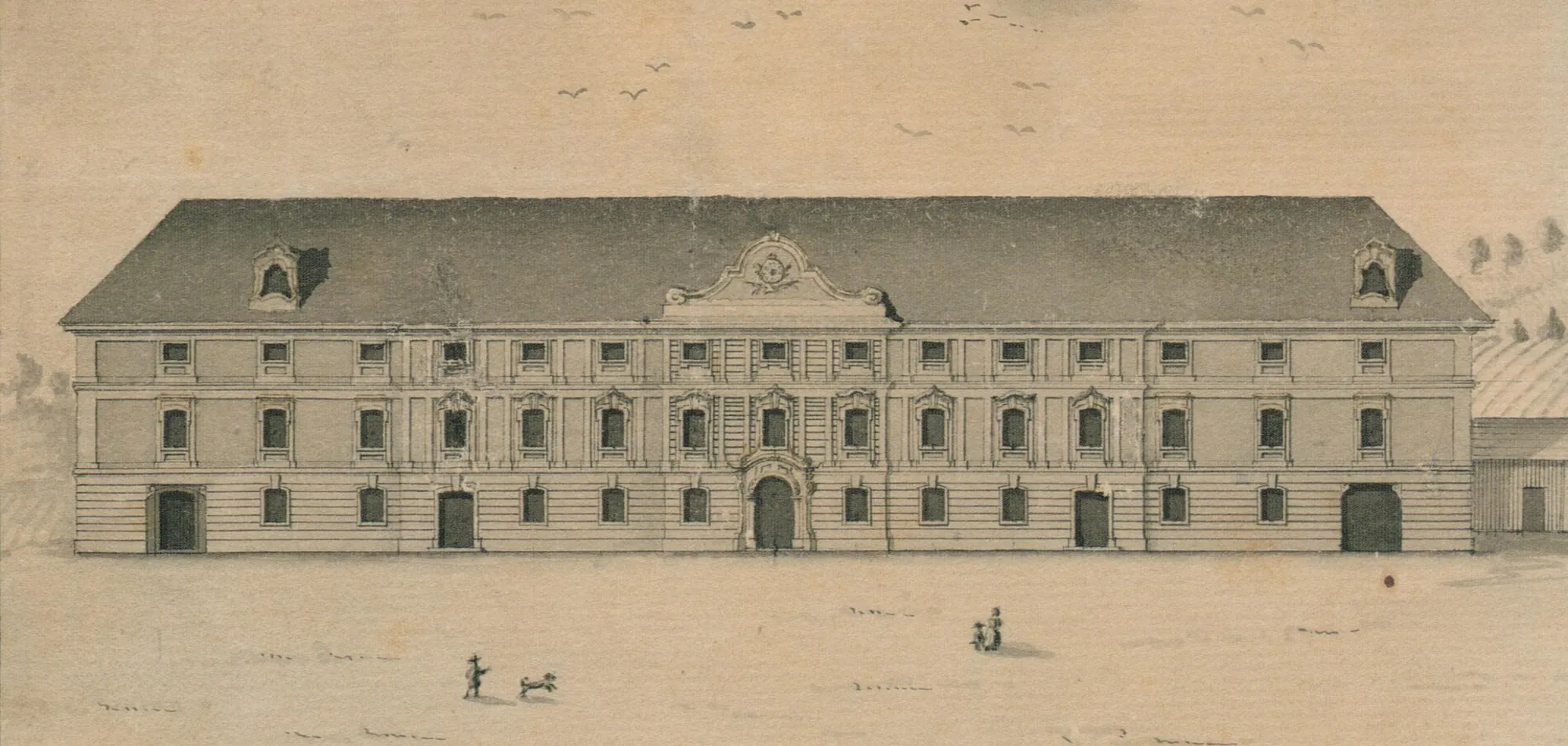
Drag the slider. Left: Joseph Leopold Wiser, view of the manor, probably from around 1765 (National and University Library, public domain). Right: the manor today, photo Doremo (CC BY-SA 4.0). The view shows a symmetrical main block. The side wings were extended in the 1820s for the stud farm, which is why the central gable is no longer in the middle of the whole building.
The cloth works at Selo
In 1724 the Carniolan Provincial Estates founded a cloth works by imperial charter, to clothe the border troops on the Ottoman frontier in home-made cloth. Two years later they bought the mill at Selo on the Ljubljanica and converted it; work began in spring 1727. It was the first textile manufactory in Carniola.
In 1747 it was bought by the merchant Friderik Weitenhiller, and in 1762 by Valentin Ruard of Vienna and Josip Desselbrunner of Ljubljana. Under them it became the first and largest cloth factory in Carniola: in 1767 they opened a spinning school, new machinery doubled output, and in 1790 the works was even shown to Emperor Leopold II. The bankruptcy of Janez Desselbrunner closed it in 1803.
Desselbrunner's manor
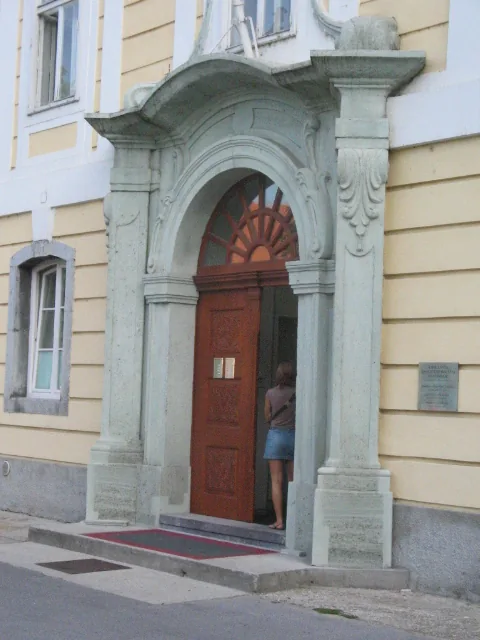
Across the road from the cloth works, where stables and sheds had stood, Desselbrunner built a manor between 1762 and 1765 to live in and to run the business from. Scholars attribute the design to Lovrenc Prager, one of Ljubljana's leading Baroque architects. The facade has a rusticated ground floor, a piano nobile and a mezzanine under the roof, 15 bays with a nine-bay central projection, and a portal linked by volutes to the window above it. It is crowned by a volute-shaped gable.
Older sources say the Jesuits of Trieste had earlier kept a summer residence with a park on this site, and the heritage register still describes the manor as built for the Jesuit college. More recent research attributes the building to Desselbrunner.
In 1789 Desselbrunner was ennobled as Edler von Desselbrunner, with a coat of arms showing a golden well. He died in the manor at Selo on 7 July 1794.
Army, stud farm and school
In 1809 a French military hospital occupied the former factory. In 1817 Andrej Malič bought the estate at auction and leased the manor to the military administration, which extended the side wings into a horseshoe and set up a stud farm in them; it stayed until 1937. The state bought the manor in 1854; after the First World War it passed to the Kingdom of Serbs, Croats and Slovenes, and in 1928 to the Ljubljana regional authority.
In 1937 the stud farm moved out and for ten years the manor housed a regional boys' school with workshops for carpenters, joiners and smiths and two primary school classes. During the occupation it was shared by the Italian and German armies.
The former cloth works across the road was bought in 1887 by Kristina Bernard, who gave it to the Carmelite nuns for a convent. It was demolished in 1951 to widen Zaloška cesta; only the house at Zaloška 58 survives.
Decline and restoration
After the war the manor went to the Yugoslav army and later served as the offices of the municipal utility, with workshops and stores. The building fell into decline. In 1994 it was declared a monument complex, and a year later a full restoration began under conservators Mojca Arh Kos, Lidija Avbelj Jelovac and Irena Vesel Kopač of the Institute for the Protection of Cultural Heritage, to plans by the architect Jani Vozel.
The central portal and the volute gable were made by the sculptor and restorer Bine Ambrožič. Under the plaster, Baroque wall paintings came to light: the ceremonial hall had painted architecture, and the overdoor panels show landscapes, among them a view of the manor with its formal garden.
Timeline
Sources (in Slovenian)
Wiser's two views of the cloth works from 1762 are held by the National and University Library of Slovenia (GR III 1195a, b), and the military plans for the 1817 conversion by the Archives of the Republic of Slovenia. Corrections and additions are welcome at david@dvorecselo.com.